Saving up for the Future
‘Saving up for the Future’ written by by Della Gooden
When Michael Caine looked up, noticed the camera and walked towards it saying: “Well, are you all settled in? …Right, we can begin” I remember thinking, ‘Hang on a minute, you’ve just had sex in that car. I don’t want you to know I’m looking… you aren’t supposed to know I’m here!’. The film that ‘gazed back’ was ‘Alfie’ and its makers made me a witness to events they knew I wouldn’t like. They anticipated a relationship with me, and yet ‘Alfie’ was made before I was born.
That same odd feeling that something is reaching out from an impossible place is also had with Mantegna’s ‘Lamentation of Christ’ (below). This is a painting of Christ laid out after the crucifixion; the soles of his feet face the viewer and his body recedes away. Some say it disappoints because ‘technically’ the feet should be bigger and the head smaller, but whether an artist has, or hasn’t deployed the mathematical rules of perspective doesn’t matter.

What does matter, is that when I viewed ‘Lamentation of Christ’ it cared where I was and it knew that it was being regarded. The kneeling mourners depicted on the left knew nothing. Busy with their grief, they will never know anything. Christ?… well, in the frozen moment of the narrative he is dead – so he didn’t know anything either. The painting, on the other hand, was working me. In fact, it worked the room. Anyone there with me, on my side of the picture-plane, would have been susceptible to its efforts and could become part of this mournful scene; made to feel hollowed out and hopeless. I am not saying the painting has a will, or consciousness, but that ‘Lamentation of Christ’ contains something latent, something waiting for you – and it can only be activated when you flick the switch with your attention. It is a little spark of energy embedded within, that was installed circa 1480 when the painting was made by the invention and labours of its maker, Mantegna.
There is a lot to enjoy about the blue, gloopy surface of ‘Blue Pleat’ (below) by Deb Covell. The paint, now dry, mimics its previously fluid state which is incongruous to its upright positioning on the wall… but there is something else; is something encased inside? …Is there something literally wrapped within it? Maybe an old, folded strip of canvas? – it keeps me wondering, holds my attention – but like the soft beating heart of a hibernating dormouse, I will never see it. In fact, I will never know if it is really there. The seeds of my curiosity were sown the day ‘Blue Pleat’ was made, when Deb Covell made something that she knew no one would ever break open to check inside.

With a surface so smooth, fine and free of blemish, no more can be asked of ‘Slider 5’ (below) by Philip Cole. It is becalmed perfection. On first looking, there are no traces of labour at all – it looks to have arrived effortlessly in the world, whole and perfectly formed. However, the disparity between the fine surface of the front and the sides that have drips and spills down them, is climactic. The front of the painting is a flawless performance – the sides are like a backstage door to its inner workings, Are the drips the remnants of a process? Did something overflow? Like the word ‘Brighton’ in a stick of Brighton Rock, does colour and shape go all the way through, right to the back? The switch has been flicked. In the studio, Cole charged the painting up with contradiction and that decision triggers intrigue in the viewer about his surfaces and studio processes.

Mantegna’s ‘Lamentation of Christ’ was purposed in its provocation of the sense of sadness and loss, but the sensations, thoughts and feelings that are triggered when we engage with a painting, the energy that is released, sometimes provokes balance and well-being.
When Stig Evans and I saw ‘Chapiteau’ (below) on John Carter’s studio wall, it struck me as so neatly packaged. A package that delivered a good deal of pleasurable accord. I could see that the three geometrical shapes of which it is formed have differences, this much was clear; the three shapes are each a different colour and each a different size. Ultimately, however, the equilibrium of my attention depended on what I hadn’t ‘seen’ or understood – something that was the same. It is a small but crucial fact (as John revealed) that all three shapes are geometrically identical.
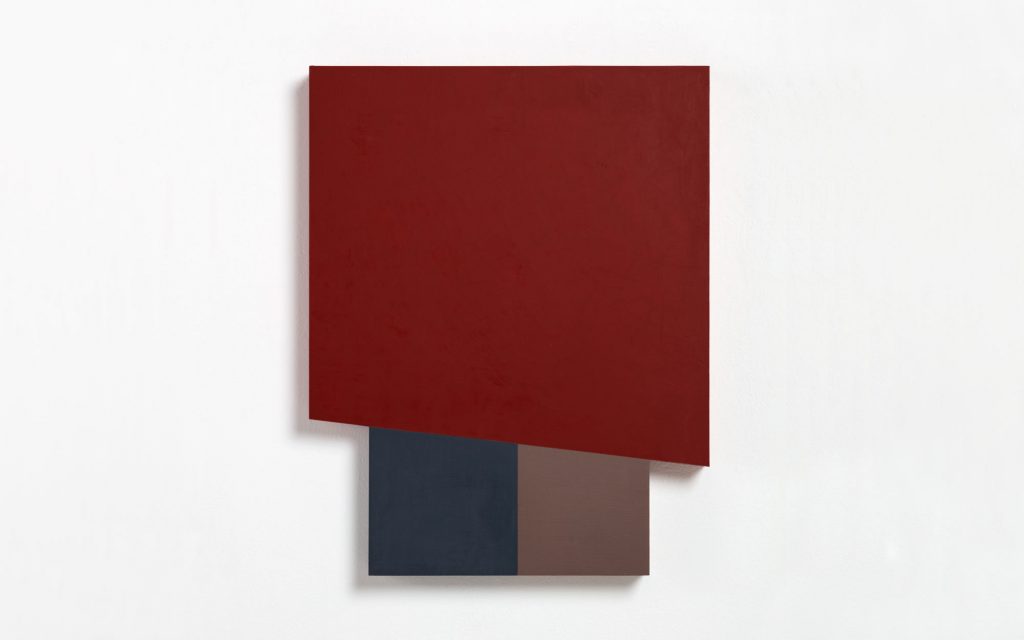
What was previously in operation below my consciousness was now in the open – it was on the pitch and at play with what I already knew. A memory of the magical and balancing role of my previous ignorance remains, but the realisation of a latent truth was discovered at a price.
Similarly, I would not have identified the circles in Katrina Blannin’s ‘Sequence #2/4 (P)’ (below) as being the same size as beer mats, side plates and pizza bases. I suspect she might argue, that actually, it wouldn’t matter too much if no one did. None-the-less, in the background, somewhere, at some level, this fact is working me; sourced in the half-noticed incidentals of life; powered by a shared knowledge of the world we see every day.

‘Saving up for the future’ by Della Gooden
Written for the exhibition ‘Hard Painting x2’
at Phoenix Art Space, Brighton, 2020.